There is something deeply unique about being in the deserts and mountains of Nevada.
The remoteness does something to you. The long sightlines. The quiet. The way the land feels indifferent to your presence but willing to reveal itself if you slow down enough. In places like this, it’s hard not to think about life, about time, about why we’re here at all. You start measuring things differently. Distance. Silence. What actually matters.
I went hunting for the first time when I was thirteen, with my dad and my grandpa. My grandpa was already sick then. Lung cancer. He could barely get around and spent most of that trip resting in the RV. But I remember the moments we did share. Sitting together. Talking quietly. Being near him in a way that didn’t require much movement or effort. He passed away not long after, the following year, and I’ve come to realize how much that trip meant to me, even if I didn’t fully understand it at the time.
Even then, I knew hunting wasn’t really about harvesting an animal. It was about being outside. About shared effort. About quiet, one on one time with my dad. About walking together and paying attention. Learning how to move through a place without disturbing it more than necessary.
That feeling stayed with me.
Years later, my oldest son shares that same pull toward the outdoors. Hunting. Fishing. Hiking. Any excuse to be outside together. In recent years, though, I’ve felt time pressing in a way I didn’t before. He’s in high school now. The days are filling up. The space between these moments is growing. I know how fast these years go, and I want the next four to matter. I want them to be memorable in ways that last longer than photos.
That day in September was meant to be simple. A chukar hunting trip with a bit of rockhounding mixed in. That combination felt natural to us. We chose the mountains between Virginia City and Washoe Valley, a landscape shaped by mining, abandonment, and stories layered one on top of another. A place that rewards curiosity more than intention.
The day itself was mostly uneventful. We didn’t see a single chukar. We checked a few old mine tailings piles and didn’t find anything particularly interesting. And honestly, that was fine. Not every day needs to deliver something tangible to be worth it.
As we started heading back down the mountain, we decided to try one last spot. We pulled off the main road into a small stand of tall junipers. As we wound through the trees, we came out into an area marked with fencing and state signs warning people to stay out and stay alive. Old mine shafts. Dangerous ground. The fences were there to keep people from getting hurt, and we respected that. We thought it was interesting, took it in, and kept driving.
We ended up looping around to the backside of the same mine area, where a small road dead ended. Curiosity took over, as it often does out there, and we got out to look around.
Not far from us was a massive round shaft, maybe thirty or forty feet across, dropping straight down into darkness. You could hear pigeons cooing from somewhere inside, but you couldn’t see them or the bottom. It was equal parts fascinating and unsettling. A reminder of how much work once happened in these mountains, and how quickly it all gets reclaimed by time.
We started walking around slowly, eyes glued to the ground. My son was scratching at the dirt near the edge of the pit, not digging, just disturbing the surface. Then I heard him call out for me, excitement in his voice.
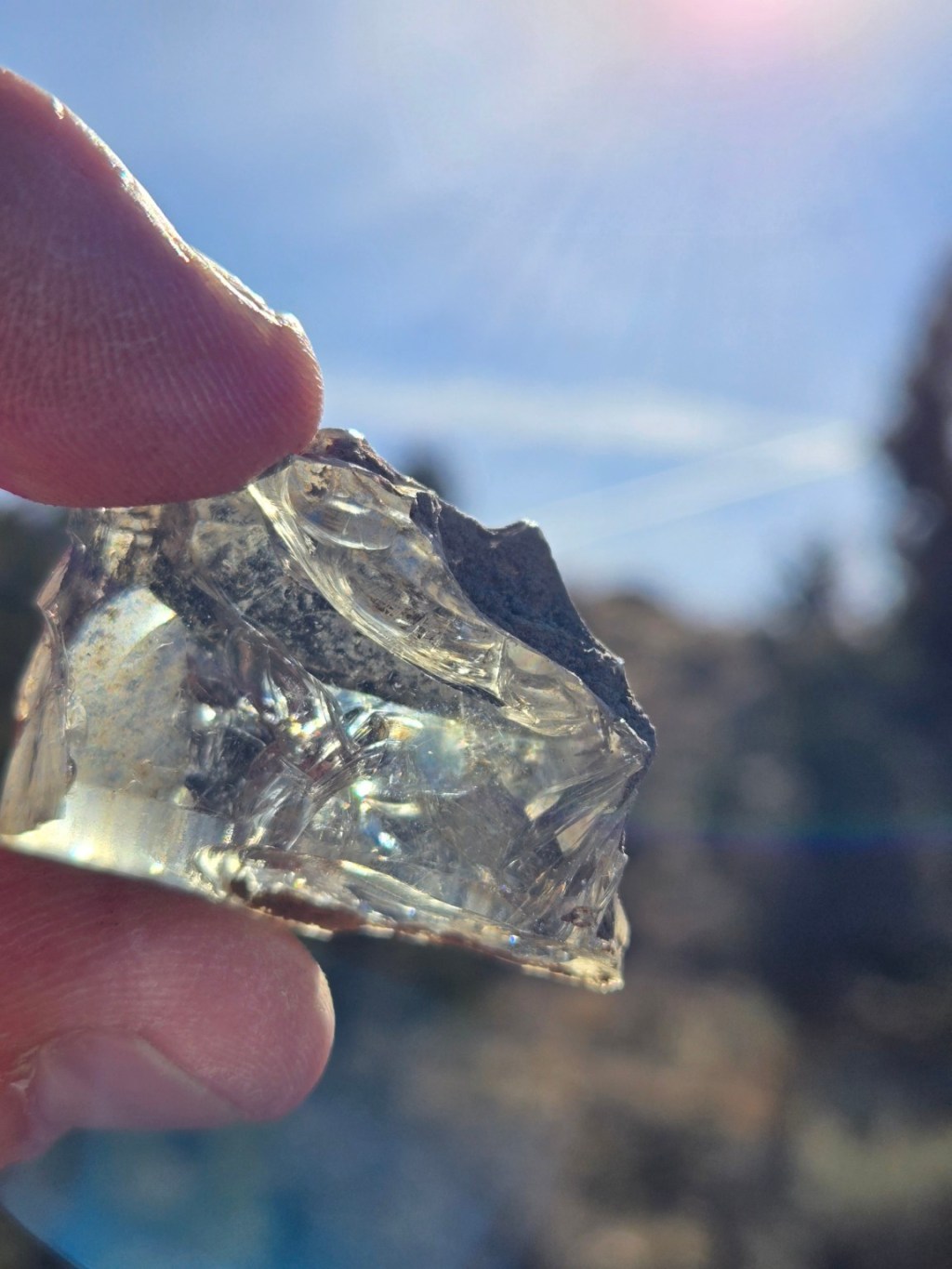
I hurried over, and there in his hand was what looked like a natural, organic piece of crystal. It had shape to it. Texture. Even a subtle opal like shimmer when the light hit it just right. We were instantly excited. That shared rush of finding something unexpected never really goes away.
We started looking around the same spot and quickly found several more pieces just under the surface. As we stood side by side examining them, trying to make sense of what we were seeing, a large wolf like dog suddenly walked through the trees right in front of us.
It stopped us cold.
Out there, in the middle of nowhere, a dog shouldn’t be there. For a moment, there was fear. Then we noticed the collar. The dog was calm. Friendly. Almost as curious about us as we were about it.
I called the number on the tag, thinking the dog might be lost. The man who answered thanked me and told me the dog belonged to him. His name was Radar. He had grown up there and wandered around the area while they were mining.
That was the first hint that this place wasn’t as abandoned as it looked.
We headed out shortly after, and as luck would have it, we actually ran into the owner on the way down the road. We stopped to talk. I admitted right away that we didn’t know it was an active claim. That ignorance was honest, not convenient. I grabbed the empty Pringles can we had put the material in and handed it to him.
I expected correction. Maybe frustration.
Instead, he smiled and said, “Let me see what you found.”
He took one look and explained that it wasn’t crystal at all. It was buried glass. Glass from the old mine boss’s shack. They used to melt down silica and pour it on site, which explained the shimmer we were seeing. Suddenly, everything made sense.
The object became less rare. And the moment became far richer.
While we were talking, the mine owner motioned quietly behind us, toward the trees.
Just beyond the edge of the clearing stood a lone wild mustang, watching us. Still. Alert. Close enough to feel real, far enough to feel untouchable. I hadn’t noticed it at all.
Before either of us could say anything, Radar did.
He took off running toward the horse, full speed, disappearing between the trees. For a brief moment, I wasn’t sure what would happen. Then we saw him slow, circle, and start jumping around the mustang, playful and familiar.
The horse responded in kind.
The mine owner smiled and said they’d known each other for years. That Radar and the horse were best friends. That they spent time together out there, moving through the same ground, the same seasons.
Watching them was unexpectedly moving. Two completely different animals, from completely different worlds, choosing connection anyway. No reason. No benefit. Just recognition.
It felt like another reminder that this place was still alive in ways we didn’t always see. That even in landscapes shaped by extraction and danger, something gentle could persist.
I told him we were just getting into rockhounding, still learning, still figuring things out. He paused, then said he wanted to give us something.
He walked to his truck and came back with a massive chunk of silver ore he had just pulled from the mine. He didn’t rush. He didn’t posture. He simply walked us through the layers in the rock, explaining what we were seeing, how to read it, what mattered.
That generosity landed deeply.
The day hadn’t given us what we thought we were looking for. But it gave us something better. A lesson in attention. In humility. In honesty. In how stories often matter more than objects.
On the drive home, the silver ore sat heavy in the truck. But heavier still was the feeling that something meaningful had happened. Not because we found something rare. But because we were present for something real.
That trip stayed with my son too. From that point on, his interest in rockhounding and our mining process only grew. It sparked something in him. Enough that he decided he wanted to create his own project, his own way of telling stories about this place. He calls it Forgotten Nevada. A space to bring forgotten places, people, and stories back to life. Broader than Stone to Story, but born from the same soil. The same ethic. The same attention.
That’s when I realized something important.
Stone to Story was never really about rocks.
It was about noticing. About being willing to be wrong. About choosing curiosity over certainty. About honoring places and people and moments that don’t demand to be remembered, but deserve to be.
That piece of buried glass wasn’t valuable.
But the story it revealed was.
And that’s enough.
 stonetostory.com
Leave a comment