
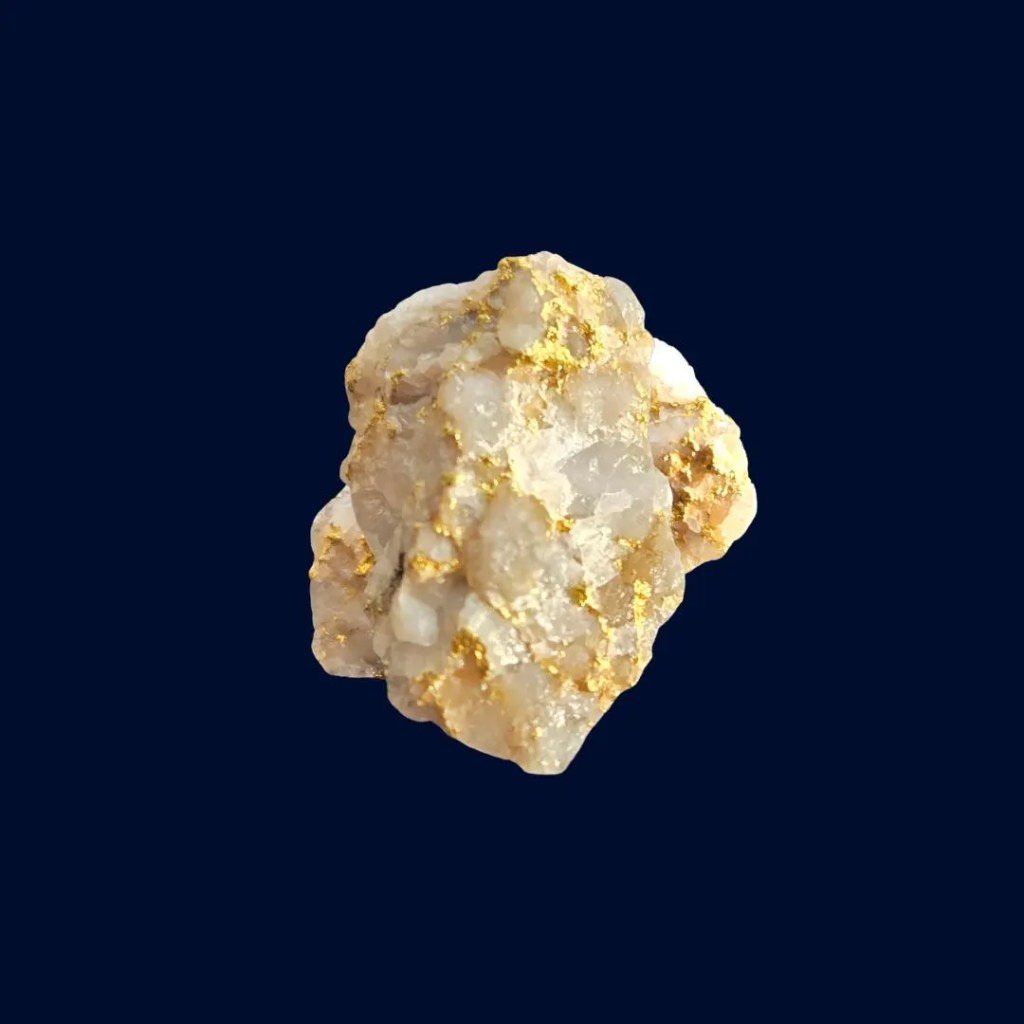
There’s a certain kind of gold that doesn’t announce itself. It doesn’t flash in a pan or settle into a jar. It stays where it formed, held in place by the rock that carried it there. This is gold in quartz, and to understand it, you have to step back into the Sierra Nevada — not as it looks today, but as it once was beneath the surface.
Long before the California Gold Rush, the Sierra Nevada was already shaping the material that would define it. Deep underground, hot mineral rich fluids moved through fractures in the rock, carrying dissolved gold through a network of cracks that would eventually harden into quartz veins. As those fluids cooled, quartz crystallized first, sealing the fractures. Gold followed, dropping out of solution and becoming locked in place, not scattered, not transported, but held exactly where the conditions allowed it to form. What would later be called the Mother Lode was not a single deposit, but a long, discontinuous system of these veins, stretching for miles and forming in pulses over time rather than in one continuous event.
When people first arrived in search of gold, they weren’t looking for this. Early miners focused almost entirely on placer deposits, the loose gold that had already eroded out of the quartz and settled into rivers. It was easier, faster, and required little more than water and patience. But something began to change as those surface deposits thinned. By the early 1850s, miners started tracing gold back upstream, realizing that the real source wasn’t in the river at all. It was still in the mountains, still embedded in quartz, and far more difficult to reach.
One of the lesser told shifts of the Gold Rush wasn’t just the movement of people, but the movement of methods. The transition from placer mining to hard rock mining marked a turning point, where miners began following quartz veins directly into the hillside, cutting horizontal tunnels, chasing narrow bands of mineralization that could disappear as quickly as they appeared. In places like Grass Valley and Nevada City, entire underground networks were developed not because gold was everywhere, but because it was incredibly specific. A vein might carry rich gold for a short distance, then pinch out completely, forcing miners to read the rock itself to decide where to go next.
That unpredictability is still visible in gold in quartz today. Unlike placer gold, which has been broken down, rounded, and separated from its origin, gold in quartz preserves the exact conditions of its formation. The orientation of the vein, the texture of the quartz, even the way the gold sits within it reflects the pressure, temperature, and chemistry of that moment. Some pieces show fine threads of gold following micro fractures. Others hold small pockets where gold collected more densely. These are not random patterns. They are the physical record of fluid movement through solid rock.
What makes this more compelling is that the Sierra Nevada was never the only place this happened. The same process repeated across the western United States, shaped by different geologic settings but driven by the same underlying forces. In Nevada, gold moved through volcanic systems tied to the Basin and Range, often associated with faulting and extension. In Oregon’s Blue Mountains, gold bearing fluids followed older, more complex structural zones. In Colorado, gold formed deep within the Rockies, later exposed through uplift and erosion. Each region produced its own variation, but all of it traces back to the same idea: gold carried in solution, then locked into quartz as conditions changed.
There’s also a detail that often gets overlooked. Gold in quartz is not just older than the Gold Rush, it’s often much older than the landscape you see today. Many of these veins formed tens of millions of years ago, long before the current shape of the Sierra Nevada was exposed. What you’re holding isn’t just a product of the mountains, it’s a remnant of a deeper system that existed before erosion revealed it. The mountains didn’t create the gold in quartz. They uncovered it.
That’s what sets this material apart. It hasn’t been moved, reshaped, or separated from its origin. It remains part of the structure that formed it, a fixed point in a process that was otherwise in motion. When you hold a piece of gold in quartz, you’re not holding gold that traveled. You’re holding gold that stopped.
And in a landscape defined by movement — shifting ground, flowing water, migrating people — that’s a different kind of story entirely.
 stonetostory.com
Leave a comment